
To deepen my understanding of AI, I completed a course in 2025 covering foundational concepts, tools, and patterns. My goal was to move beyond using AI as a productivity tool and learn how to craft experiences with it. As a capstone project, I built the first iteration of an AI career coach app that explores personalized guidance, conversational interactions, and skills development.
Tools used: Lovable, ChatGPT, Hugging Face, Whisper, Supabase, Github, Runway, Visily, Story-boards.ai
the idea.
Meet Elevate.
Elevate is your AI-powered career coach, making expert guidance accessible. It addresses the challenges of finding mentors by providing personalized feedback, interview and presentation practice, and achievement tracking, all while evolving with you. It's a dedicated career strategist in your pocket, helping you build skills and confidently navigate your path to impact and promotion, especially if you don't have traditional networking advantages.
AI stack
Not every technology is implemented into the prototype, but the following is the stack required for a fully realized app:
LLMs: Real-time assistance, recommendations, simulate practice interactions
NLP: Feedback analysis, interpret user questions, identify underlying goals and specific skill gaps and challenges
ML/reinforcement learning: Learn from user interactions, refine coaching and content recommendations
Automatic speech recognition: Convert the user's spoken words into text for the AI to process
Text-to-speech: Deliver the AI's response audibly
Natural language understanding: Interpret the meaning and intent within the user's input to understand what the user is asking or expressing, even if the phrasing is complex or informal
Natural language generation: Craft the response into natural-sounding human language
Voice activity detection and turn-taking models: Detect when the user starts and stops speaking, allowing the AI to know when it's its turn to respond
the audience.
Career growth isn't always limited by ambition – it's often a matter of access. Professionals looking to advance their careers or step into leadership roles can struggle to find mentors, afford the high cost of coaching programs, or get advice tailored to their specific goals and challenges.
As a result, many navigate critical career moments without the support needed to grow with confidence.

the concept.
Leveraging a recombine exercise, I used the following to inspire Elevate’s primary interactions:
Sims: A game that allows users to select traits or personas like “Creative” or “Loner”, which affects how the Sim behaves and how they react to others. Personalizing personas can better craft communication styles to specific behavioral and personality styles.
Improv: Improv builds skills to think quickly, act under pressure, and respond to unexpected feedback. AI could help users quickly embody different communication styles (assertive, empathetic, diplomatic).
Framework: Common frameworks (like COIN, STAR, CLEAR) can reinforce communication skills, how to give and receive feedback, and strengthen interview skills
Journaling: Writing down reflections can help with recall of what went well and what could have been improved in situations, including presentations or giving/receiving feedback
the storyboard.
Story-boards.ai produced the storyboard images, where I encountered some challenges creating consistency with the main character. It took several rounds of reference images and prompts to get some accuracy.
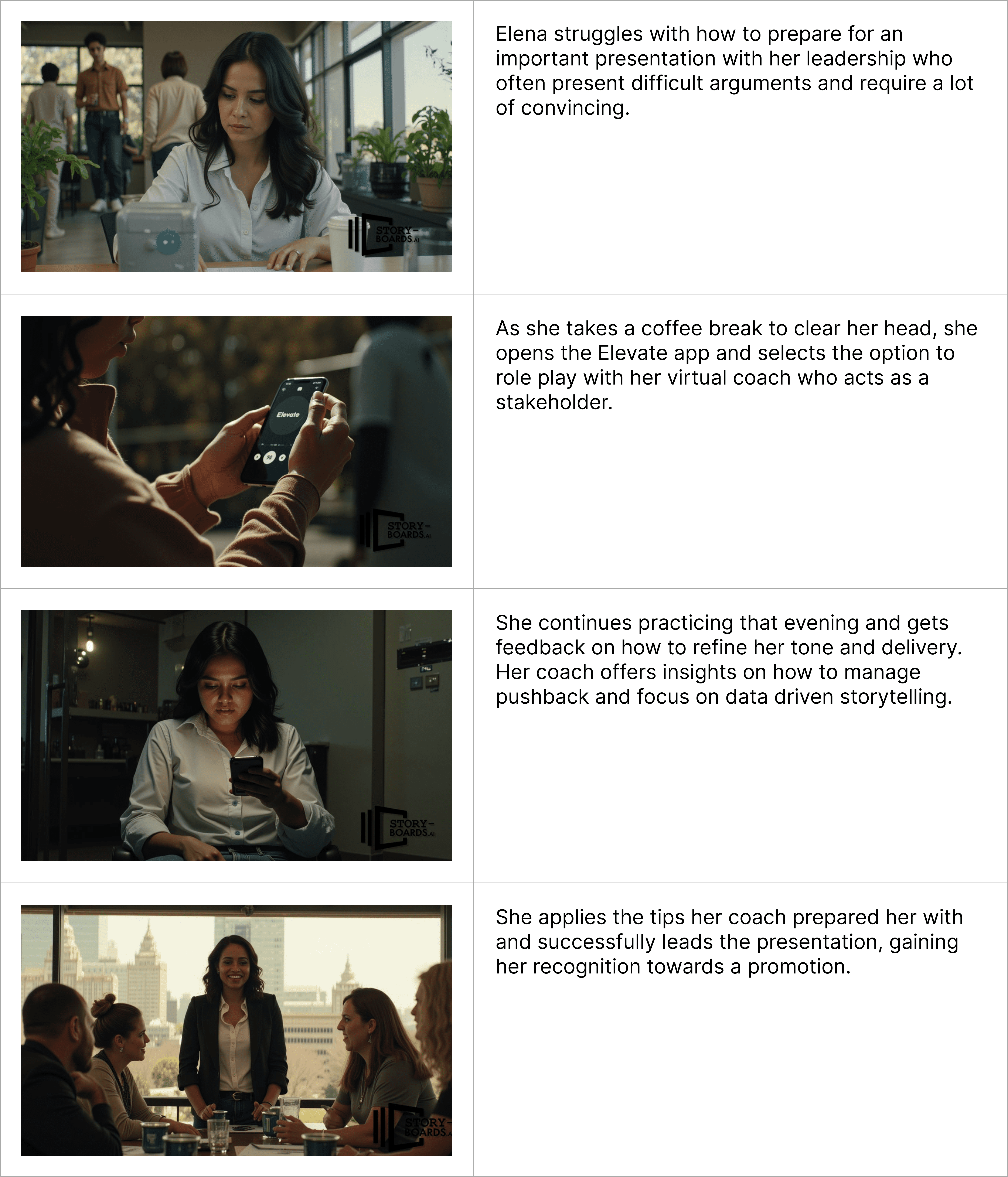
key features.
Personas: Set up personas of your team and stakeholders to practice communication skills for things like requesting promotions, giving feedback, or having difficult conversations
Personalization: Your AI coach will curate responses and personas to your needs, and adapt as it learns more about you
Practice scenarios: Lead with confidence in any 1:1, presentation, and giving feedback through AI driven practice sessions and communication frameworks. Practice with audio only or audio and video – you’ll get feedback on tone, delivery, pacing, and body language
Job interviews: Practice interviews and get tips to create the most effective resume
Coaching and goals (future feature): Set short to medium term goals and Elevate will develop coaching plans with regular check ins and action items
Achievement tracking (future feature): Your coach will follow up after interviews and presentations with feedback, and you can journal to document progress on goals (this will help train your coach)
first explores.
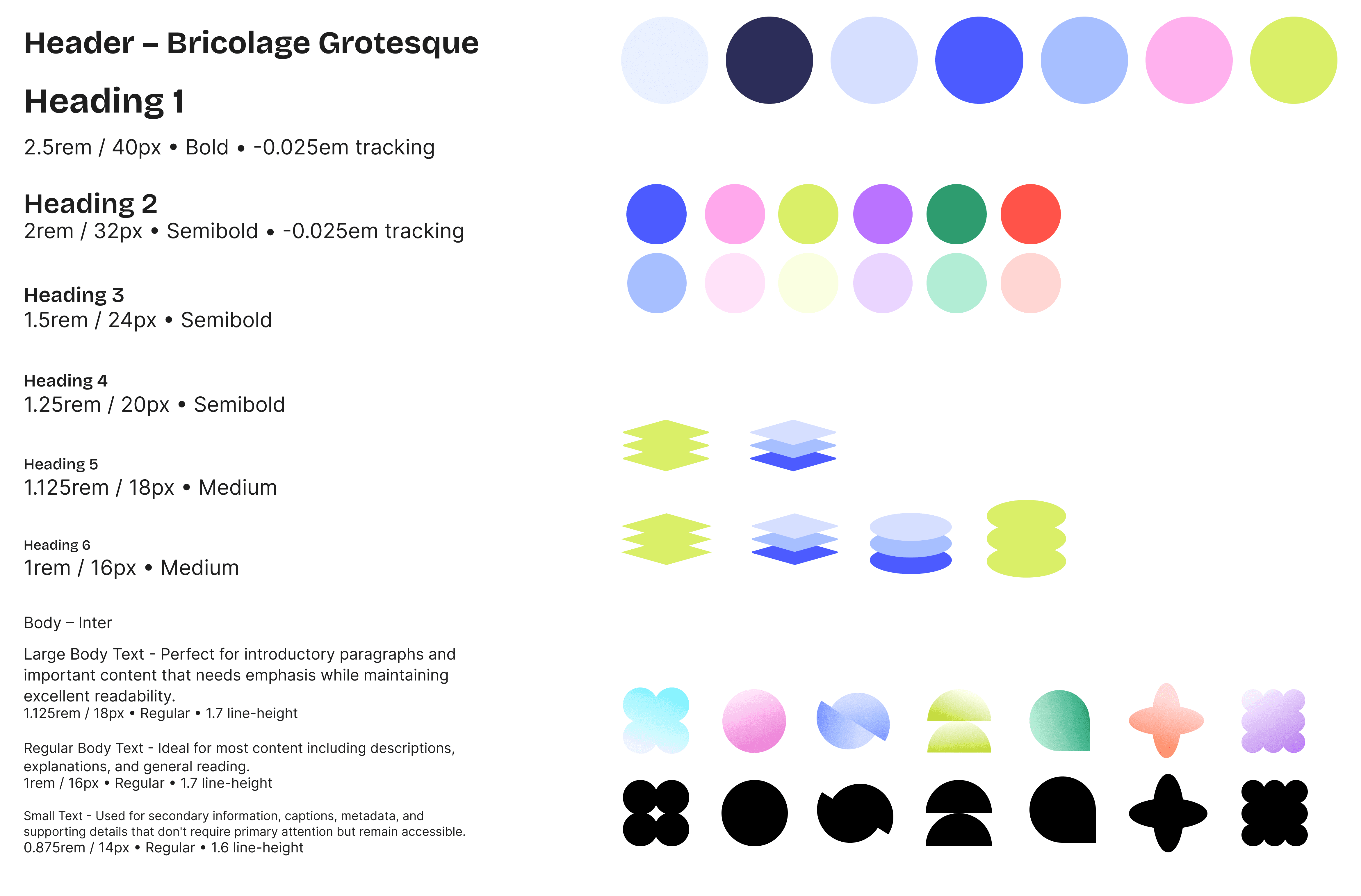
I explored mocks with Lovable, Figma Make, and Visily to compare initial outputs. Several rounds of prompts outlining interactions and brand guidelines continued to produce similar generic results, leading me to craft my own brand assets to have finer control over the visual language.

final.
The final project became a balance of AI tooling and the human touch. I designed a base style guide, which I fed into Lovable’s project knowledge along with model details:
• Automatic speech recognition: Whisper
• AI Coach Chat: gpt-4o-mini routed via Supabase Edge Functions (with mock fallbacks for testing)
I had limited time to map and build everything out, which required prioritization of what I could achieve and what would be a future state. I was able to prototype the core features: building out the primary flow, patterns to create personas, and a functional environment to practice presenting with live video and audio.

Improving one’s communication and storytelling skills were a key part of this project. Interacting with a generic LLM wouldn’t be enough – inspired by Google AI Studio’s temperature controls, I created a slider pattern that could define nuances in conversational traits and closely mirror real personalities.

next steps.
Models have greatly improved since this project, and the latest can greatly improve the performance of this project
Explore additional models to make the experience more robust (STT for the AI coach)
More sophisticated tracking of progress, conversations, job interviews, etc.
Better incorporate recombine features to build out coaching and improv practice features